
Operational databases
MySQL, PostgreSQL, SQLite, and other SQL databases. The transactional data your business actually runs on. Inquerio AI reads them directly, with read-only enforcement that rejects anything that isn't a query.
Inquerio AI plugs into what you already run. No data is moved, no system is rebuilt, and nothing leaves your perimeter.
Point Inquerio AI at a system, confirm what it discovered, and start asking.
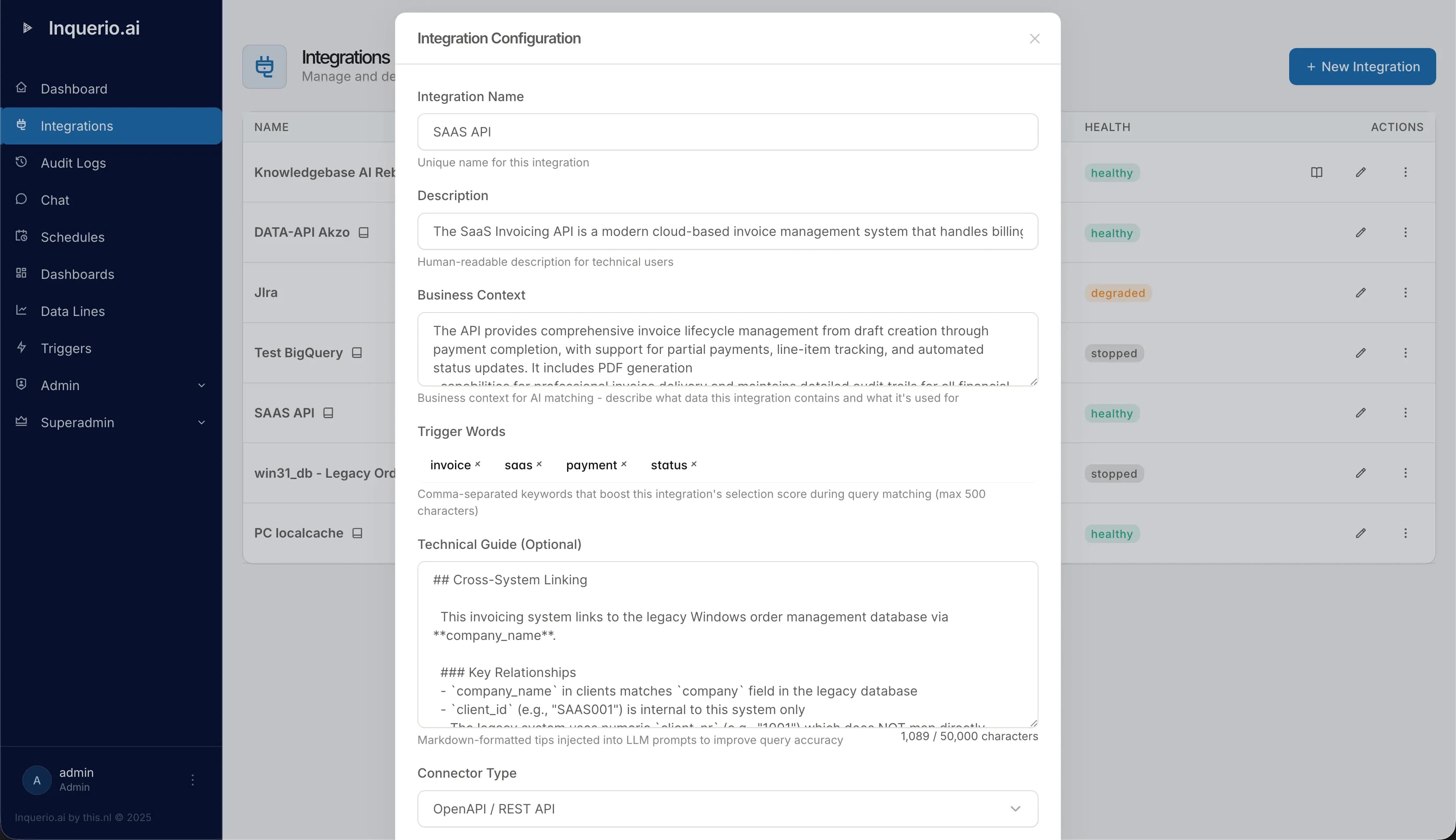
If your data lives in one of these, Inquerio AI reaches it.
MySQL, PostgreSQL, SQLite, and other SQL databases. The transactional data your business actually runs on. Inquerio AI reads them directly, with read-only enforcement that rejects anything that isn't a query.
Anything with a REST or GraphQL endpoint: your CRM, billing, ticketing, internal services, public APIs. Inquerio AI reads the API's own description and learns what it offers.
Salesforce, HubSpot, Shopify, Stripe, Google Sheets, Zendesk, Slack, Microsoft 365, Linear, ServiceNow, Jira, and more. Each is reachable through the same connection model as a database.
PDFs, spreadsheets, and Word documents are attached to a question or a trigger. Inquerio AI extracts the text and uses it as context, then forgets it. Files don't have to live in a separate document store.
Inquerio AI examines what the system offers, learns its structure, and starts answering questions based on it. No manual catalog. No semantic layer to maintain.
A connection string for a database, a base URL, and credentials for an API, the standard credentials your SaaS already issues. Read-only access is enough.
Tables, columns, endpoints, types, and relationships are discovered automatically. The catalog stays in sync as the source changes.
From the moment a connection is live, anyone with the right access can ask questions.
Inquerio AI runs inside your environment and queries your sources directly when a question is asked. There is no nightly batch job, no warehouse copy, no data lake replicating tables.
Source systems stay the source of truth. The answer you read is the answer that exists in the system right now.
That also means you do not inherit a second compliance footprint: the data Inquerio AI sees is the data already governed by the source it came from.
A new system doesn't just add its data; it unlocks every cross-system question that touches it. Two systems connected are the minimum useful unit.
Inquerio AI's database access is enforced as read-only. Nothing it does to a connected system can change, delete, or insert data.
The same connection model handles your decade-old transactional database and your current SaaS. Operational and IT teams aren't learning a different tool per source.
Tell us about two of your systems. We'll show you Inquerio AI answering a question.